E-Visa vs Visa on Arrival: What's the Real Difference?
People mix these up all the time and end up stuck at immigration. They're not the same thing — here's what actually matters.
"E-visa and visa on arrival are basically the same, right?" No. And the number of people who've found this out at 2 AM at a random international airport is higher than you'd think. They're fundamentally different in how they work, how much they cost, and — most importantly — what happens if something goes wrong. Here's the actual difference and when to use which.
Visa on arrival (VOA)
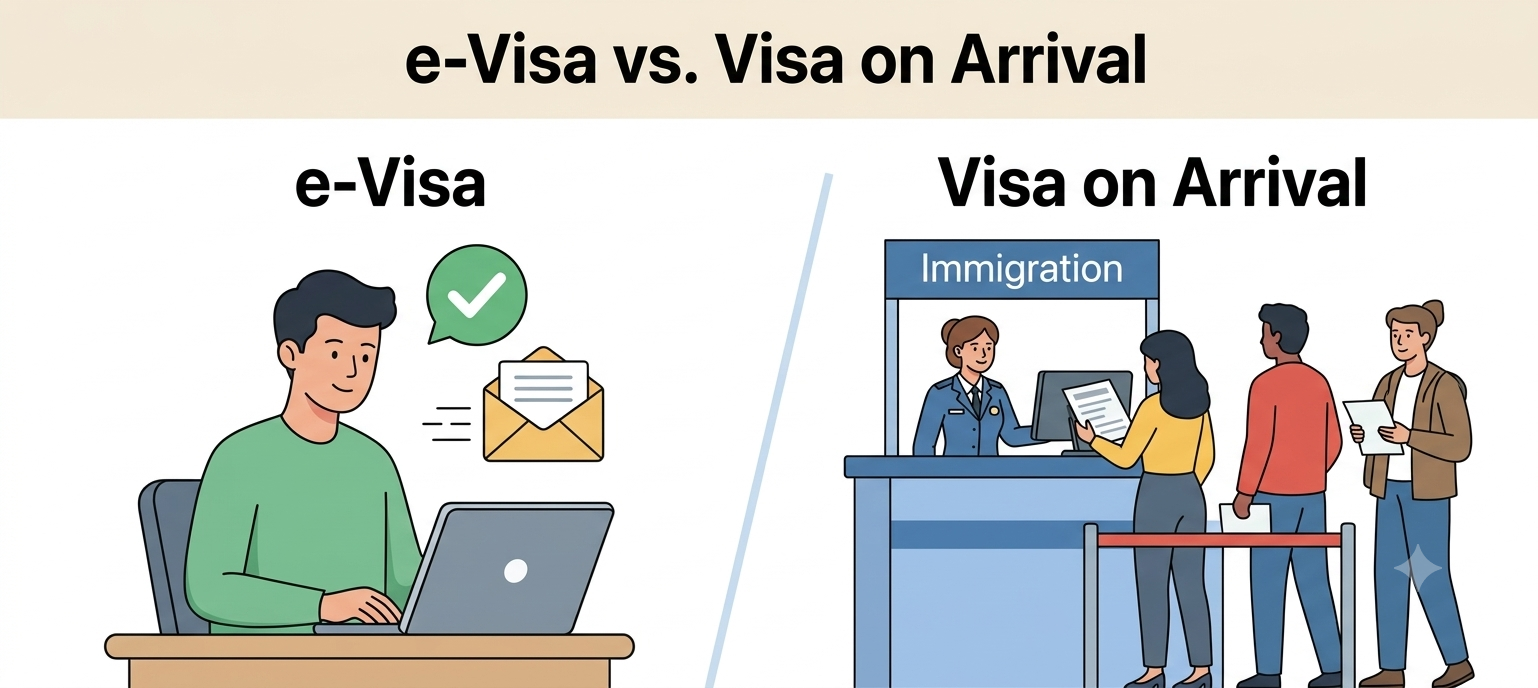
You land, you queue at a special counter, you fill a form, pay in cash (usually USD), get a stamp, walk through. Everything happens at the airport.
The upside: No advance paperwork. Great if you decided to travel last-minute.
The downside: If something goes wrong at that counter — insufficient cash, wrong denomination, closed counter, "system down" — you have very few options. You're already in the country's immigration hall. Worst case: they put you on the next flight back.
E-visa
You apply online days or weeks before your trip. You upload passport scan, photo, sometimes hotel booking and flights. You pay by card. You get a PDF visa emailed to you. You show that PDF (printed or on your phone) at immigration when you land.
The upside: You know before you fly whether you have a valid visa. Zero airport risk. Card payment. Applies from home.
The downside: You have to plan ahead. Processing is usually 3–7 days, sometimes longer.
The key insight most people miss
With VOA, the airline lets you board without confirming you have a visa. They trust that immigration at the destination will issue one. With an e-visa, the airline actually checks your e-visa PDF at check-in — if it's missing or invalid, they won't let you board. This sounds like a downside for e-visa, but it's actually protective — you find out you have a problem before you're airborne with unfixable consequences.
When to use which
Use VOA when:
- The country's e-visa system is slow or unreliable
- You're making a last-minute trip and don't have time for e-visa processing
- You have a confirmed onward ticket, cash in USD, and know exactly what you're doing
Use e-visa when:
- Both options are available (this is most countries now)
- You want zero risk of an airport surprise
- You'd rather pay on your card in INR-equivalent than carry USD
- The country's e-visa is well-established (Vietnam, Turkey, Kenya, Uzbekistan, Egypt, Cambodia, Sri Lanka)
The cost angle
Interestingly, e-visas are often the same price or slightly cheaper than VOA, because there's no counter, no cash handler, no printed sticker. Vietnam's e-visa is $25, VOA is $25 + often a "service fee" from the airport agent. Cambodia's e-visa is $30, VOA is $30 in cash. Kenya's e-visa is around $50, VOA is $50 in cash plus fees. Small edge to e-visa in most cases.
Common failure modes I've seen
- Landed with a torn USD bill for VOA — refused, had to change money outside secure zone, missed connection.
- Assumed VOA existed for Vietnam — hasn't for Indians in years. Denied boarding at Bangkok.
- Printed e-visa PDF but it was cut off — immigration officer wanted a full copy.
- Applied for e-visa 2 days before travel — processed the day after departure. Visa unused.
All avoidable with 15 minutes of prep.
What to check every single time
- Does your specific passport nationality qualify for the version you're using? (VOA and e-visa can have different eligible-country lists.)
- What's the current fee, and what payment methods are accepted at the counter/portal?
- What supporting docs do you need? (Usually onward ticket + hotel + passport photo.)
- How long is the visa valid, and how many days can you stay?
- Is single-entry or multi-entry?
The IATA Travel Centre and the destination country's official immigration site are the sources of truth. Every other source (blogs, YouTube, WhatsApp) can be outdated.
One more thing: onward-ticket requirement
Both e-visa applications AND immigration officers at VOA counters can ask for proof of onward travel. Never travel on a one-way with no plan. If you don't have your return leg booked yet, use a proper flight reservation for the exit — don't block money on a real ticket you might not use.
Bottom line
E-visa first, VOA as fallback. Whenever both exist, e-visa gives you certainty before you fly and a paper trail if anything goes wrong. VOA is fine but it's a "trust the process at 2 AM in a foreign airport" strategy. Given the choice, I'll take the boring 10-minute online form every time.
Comments
Log in to view and join the conversation
Log in